
Accredited · Ministry authorized
Sound insulation and building acoustics.
We test sound insulation of buildings on site: walls and floors between apartments, impact sound, façades and windows, plus reverberation time and sound power of sources, all within ATS accreditation 01-008. For environmental noise see Noise measurement.
- ATS 01-008accredited lab
- ISO/IEC 17025:2017
- since 2001accredited
- ASound source (dodecahedron)
- BSeparating wall
- CSound level meter
- DStructural vibration
- ESound insulation rating
- 1Sound source in the source room
- 2Sound passes through the separating element
- 3Level measured in the receiving room
- 4Sound insulation rated to the standard
What we measure
Sound insulation & building acoustics
Noise measurement
Environmental, residential and workplace noise measurement has its own page with regulations, process and FAQ.
Workplace noise and noise sources
Workplace noise, sound power of machines and equipment (EN ISO 3744 and 3746), noise from mechanical, electrical and plumbing installations.
Sound insulation between rooms
Field airborne sound insulation of walls and floors (EN ISO 16283-1, rated to EN ISO 717-1).
Impact sound
Field impact sound insulation of floors (EN ISO 16283-2, rated to EN ISO 717-2).
Façades
Insulation against outdoor noise for façades and windows (EN ISO 16283-3).
Reverberation and vibration
Reverberation time in rooms and halls (EN ISO 3382-2) and vibration and shock testing of machines, equipment and tools.
Accreditation and standards
ATS 01-008 scope of accreditation
The tests on this page are covered by the scope of accreditation of our Testing and Measurement Laboratory. Reports carry the accreditation mark; methods and ranges are listed below.
- Accreditation No.
- ATS 01-008
- Standard
- ISO/IEC 17025:2017
- Initial accreditation
- 3 Sep 2001
- Valid until
- 15 Mar 2027
| Subject | Test | Range | Reference document |
|---|---|---|---|
| Environment | Determination of noise levels | 20–130 dB | SRPS ISO 1996-1:2019; SRPS ISO 1996-2:2019 |
| Noise sources | Sound power level of noise sources | 20–130 dB | SRPS EN ISO 3744:2011; SRPS EN ISO 3746:2011 |
| Building materials, elements, structures, buildings and halls | Field measurement of airborne sound insulation of façade elements and façades | 20–80 dB | SRPS EN ISO 16283-3:2017; SRPS EN ISO 717-1:2021 |
| Field measurement of airborne sound insulation between rooms | 20–80 dB | SRPS EN ISO 16283-1:2016/A1:2018; SRPS EN ISO 717-1:2021 | |
| Field measurement of impact sound insulation of floors | 20–80 dB | SRPS EN ISO 16283-2:2021; SRPS EN ISO 717-2:2021 | |
| Reverberation time measurement | 0.1–20 s | SRPS U.J6.057:1982 (withdrawn); SRPS EN ISO 3382-2:2010 |
Environmental noise: Ministry of Environmental Protection, decision No. 003239252 2025 14850 003 005 501 069 of 20 Oct 2025.
Process
How it works
- 01
Objective
We establish what is being assessed: limit values, design or standard requirements.
- 02
Plan
Measuring positions, timing and operating conditions.
- 03
Measurement
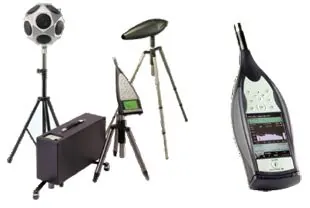
Sound level meter, with a sound source or tapping machine for insulation tests.
- 04
Processing
Indicators such as noise level, R′w, DnT,w or L′nT,w.
- 05
Assessment
Comparison with limits or requirements.
- 06
Report
Test report with noise control recommendations.
What you get
Report and results
- Environmental or workplace noise report
- Sound insulation test report with single-number ratings
- Compliance assessment
- Frequency spectra
- Noise reduction recommendations
Who needs it
Who we work for
- Residential developers before handover
- Hospitality venues and industry
- Buildings with rooftop HVAC plant
- Residents and managers in noise disputes
- Designers and acoustic consultants
- Local authorities
Guide
Noise and sound insulation testing: when and how
Environmental noise
Environmental, venue, HVAC, residential and workplace noise is covered on the Noise measurement page. This page deals with sound transmission through building elements.
Sound insulation of walls and floors
Airborne sound insulation between rooms is measured on site to EN ISO 16283-1 and rated to EN ISO 717-1. The result is a single number, such as R′w or DnT,w, compared with the requirement for that type of partition.
Impact sound
Impact sound insulation of floors is measured with a standard tapping machine to EN ISO 16283-2 and rated to EN ISO 717-2, a common source of complaints in residential buildings.
Façades and windows
Façade sound insulation is measured to EN ISO 16283-3, which matters next to busy roads and when checking installed windows.
Reverberation time and sound power
Reverberation time is measured to EN ISO 3382-2, and the sound power level of noise sources to EN ISO 3744 and 3746.
When to order a test
Typically before handover of a new building, after residents report noise, when checking built walls and floors, and when an inspector or investor requires an accredited laboratory report.
FAQ
Frequently asked questions
Who may measure environmental noise?
An organization holding a decision of the Ministry of Environmental Protection. Instalacija Inženjering is on the Ministry list (decision of 20 Oct 2025), and the methods are also in our ATS scope.
What is measured in sound insulation tests?
For airborne sound, the level difference between the source and receiving rooms; for impact sound, the level below while a tapping machine runs on the floor. The result is a single number such as R′w or L′nT,w.
Do you measure vibration?
Yes, on request. The testing area in our scope also lists vibration and shock of machines, equipment and tools; before quoting we confirm the method and whether the specific test is covered by the accreditation.
Can you measure at night?
Yes, environmental noise is measured in the assessment period, including night time.
Contact
Tell us what needs testing.
Send the building type, location and the test you need, and we will reply with a quote and a date.
